Do You Repair Radiant Floor Heating in Homes and Businesses?
Yes, we repair radiant floors in houses, condos, garages, shops, and commercial buildings. Let us know the property type and which rooms have stopped heating.
Radiant Floor Heating Repair Kings provides radiant floor heating repair, heated floor leak detection, and electric floor heat troubleshooting services in the Norwalk, CT area for both residential and commercial properties, covering hydronic tubing systems and electric cable and mat floors. Contact us now for a free estimate.
Radiant floor heating repair in Norwalk, CT costs anywhere from $420 to $1,890 on average for a single fault, such as one tubing leak, a broken heating cable, or a failed pump or valve. The price depends on whether the system is electric or hydronic, how hard the fault is to locate, the flooring over it, and how much floor has to be opened and patched.
Yes, we repair radiant floors in houses, condos, garages, shops, and commercial buildings. Let us know the property type and which rooms have stopped heating.
Yes, we cover the Norwalk, CT area. Send us the property address and we'll confirm.
Yes, we repair electric cable and mat floors and hot water tubing systems. A photo of the thermostat or manifold tells us which you have.
Yes, we work on systems other installers put in. Layout drawings or photos taken before the floor went down help us find the problem faster.
Most visits can be scheduled within a few days, though peak heating season can push that out. Tell us if water is showing so we can try to come sooner.
We need the address, the system type, which rooms are cold, the floor covering, and the system's rough age. Photos of the thermostat, manifold, and any error code help.
No, as long as we can reach the thermostat, panel, and manifold. It helps to be there at the start to agree where we open the floor.
Yes, but the landlord has to approve it first, since a repair can mean cutting into tile or concrete.
Yes, we confirm the price before starting. If opening the floor shows more damage, we stop and talk to you first.
Yes, sometimes. Many heating cables and tubing carry a maker's warranty, but it may not cover labor, and DIY repairs can void it. Send us the brand and install date so we can check.
We finish most repairs in a few hours to a day. Thermostat and valve swaps are quick, while leaks and cable breaks under tile or concrete take longer.
No, not always. Many faults are in the thermostat, pump, valves, or manifold. When the fault is in the floor, we open only the small area over it.
Cold patches usually mean a broken cable, air in a loop, a stuck zone valve, or a leaking loop. Tell us if it's one spot, one room, or one zone.
We isolate each loop at the manifold and pressure test it, then pinpoint the leak with thermal imaging, acoustic equipment, or tracer gas.
We test the cable's resistance against the maker's rating, then use a fault locator or thermal camera to find the break.
Yes, we usually trace it to the zone valve, its 24 volt transformer, or the thermostat, and fix it without touching the floor.
Yes, we check the mixing valve that sets the water temperature going to the floor, along with the boiler setting and thermostat.
Yes, we find whether it's a damaged cable, wiring, moisture, or a bad breaker. Don't keep resetting it.
Yes, we test the floor sensor's resistance first, since a thermostat error code often points to the sensor rather than the thermostat itself.
Yes, we purge each loop at the manifold, usually 10 to 15 minutes per loop. If air keeps returning, we look for a leak.
Yes, if your manifold has purge valves. If it still gurgles afterward, call us, since that points to a leak.
Yes, a falling gauge usually means a leak or a failed valve, and we track down which. Most home systems run around 12 to 15 psi, and an automatic feeder can hide a leak by topping up water.
Yes, we can power or chemical flush the loops to clear sludge and rust. Orange water when purging usually means metal parts are corroding, so we also look for the source.
Yes, a failed circulator is a common reason floors stop warming. We fit a pump sized for the system, then refill and bleed it.
Yes, the manifold and its fittings are where most hydronic leaks start. Send us a photo of the manifold and tell us where you see water.
Yes, in most cases. We remove a few tiles, splice the cable with a repair kit, retest it, and reset the tile. Spare tiles help the patch match.
Yes, floating floors can often be lifted and relaid, while glued or nailed hardwood has to be cut out and patched. Tell us the flooring type.
Yes, nicks from a trowel, cutter, or nail are a common repair. Some makers cover install damage, so check the paperwork first.
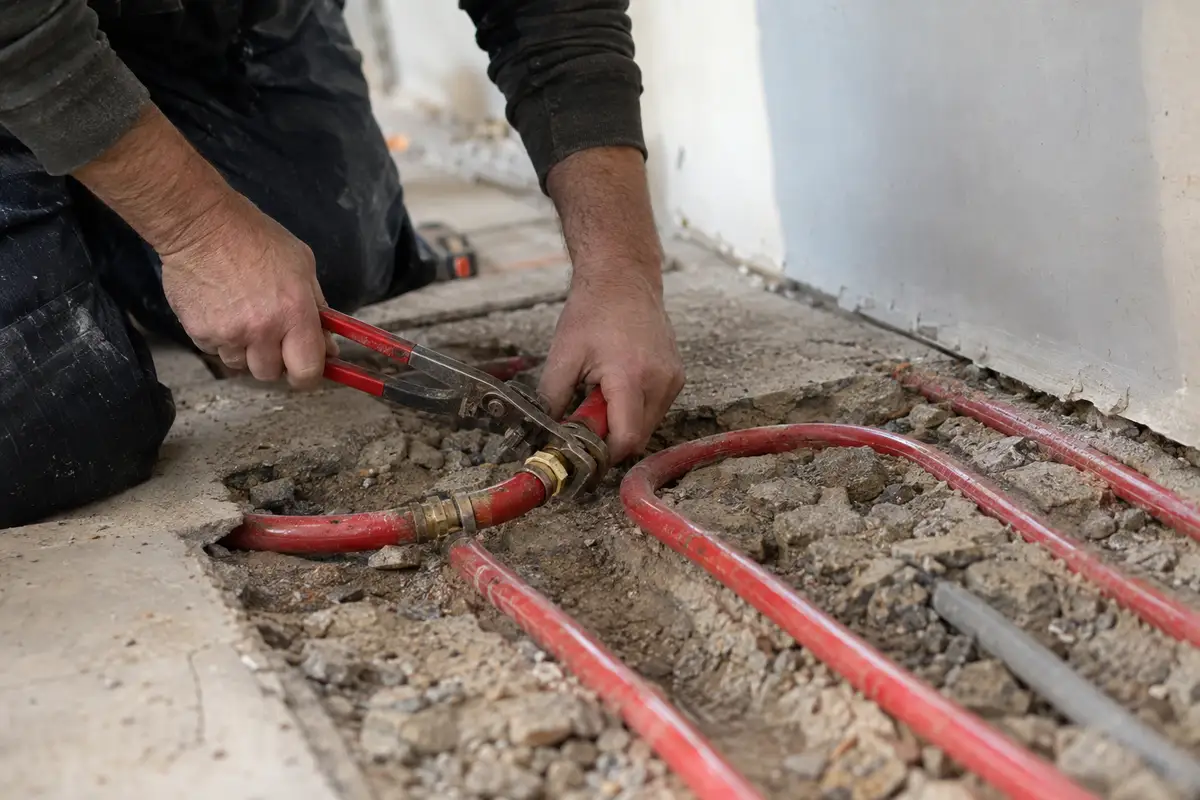
Yes, we cut out a small section of concrete, splice in new tubing, pressure test it, and patch the slab.
Yes, tubing stapled up from a basement or crawlspace can usually be reached from below.
Yes, copper can usually be cut and brazed. Steel leaking in several places tends to keep failing, so we'll tell you if repairs stop making sense.
Yes, we can splice a failed section, but Entran II rubber tubing from about 1989 to 1994 tends to crack as it ages, so more leaks are likely and re-piping may be the lasting fix.
No, shut it off if you see water or stains below, since a running leak can rot the subfloor. Let us know what you see.
Yes, thick rugs and heavy furniture block the heat and can make a working floor feel cold. Move them first, and if the bare floor is still cold, we'll test it.
No, not reliably, and sealants can clog valves and pumps. We fix the leaking section instead.
Yes, we can close a loop at the manifold, but that area will stay cold.
Yes, in most cases, for a single leak or cable break. If repairs near half the cost of a new system, or leaks keep appearing, we'd usually suggest replacing it.
Yes, we patch concrete and reset small areas of tile. Hardwood refinishing or carpet work may be quoted separately.
Hydronic systems can usually restart once the pressure test passes, though we'll tell you if a concrete patch needs time first. Electric cable under freshly set tile typically needs 7 to 10 days for the adhesive to dry.
Yes, we check pressure, bleed the loops, and test the circulator, relief valve, and controls.
